
Hurricanes create their own category
Fulfilling Rod Brind'Amour's vision, the Stanley Cup champs are right at home.

To this day we don’t know what Peter Karmanos was thinking, back in 1997, and some people in Hartford have neither figured it out nor forgiven.
The Whalers were Hartford’s NHL franchise. Not New York’s and not Boston’s, but its own, and even though the Whale didn’t win a lot of games, it still had Ron Francis and Pat Verbeek and a campy goal-celebration song called Brass Bonanza. Gordie Howe got to the point he couldn’t bear to hear it anymore. But that was no reason to move.
Especially since Karmanos, the owner, moved the Whalers to North Carolina, a place that was utterly bereft of hockey culture except for a few dogged fans of the Eastern Hockey League. Not only that, Karmanos moved the Whalers to Raleigh, which hadn’t yet built an arena. The Whalers-turned-Carolina Hurricanes had to spend two years in the Greensboro Coliseum, in front of well-spaced fans, and their games weren’t often televised, and their radio broadcasts were pre-empted by North Carolina State basketball, and the players lived and practiced an hour away. And there was educating to be done. A Raleigh newspaper columnist came to the first game in the new building and, after the second period, said, “Damn. You mean they got two halftimes?”
But Rod Brind’Amour, 33 at the time, came to Raleigh in early 2000 and saw promise. A fan base was building. Thousands of tech and medical workers and other businessmen were moving south to the Research Triangle Park, and bringing hockey hunger with them. Brind’Amour envisioned a place where Hurricanes alumni would settle down, where players would be attracted to the mild climate and the many golf courses and the low demands. He married the daughter of Eddie Biedenbach, a prominent N.C. State basketball player of the 60s, known as the Pittsburgh Pickpocket.
Brind’Amour became the team captain and, in 2006, won the Selke Trophy. More to the point, the Hurricanes won 52 games and then the Stanley Cup. Tailgaters gathered, merchandise flowed out of the shops, and a real connection was forming. Coach Peter Laviolette also made fortuitous calls. Down 2-0 to Montreal, he subbed out goalie Martin Gerber and put in Cam Ward. The Hurricanes won that series, and Ward then went bad for a couple of games, then came back again. Ward became the Conn Smythe Award winner, the MVP of the playoffs. Brind’Amour noticed that, too.
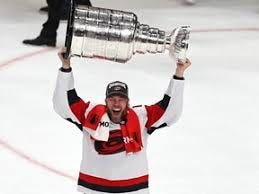
On Sunday, the Hurricanes won their second Stanley Cup, capping a 6-game conquest of Vegas with a 3-0 victory on the road. Afterward, captain Jordan Staal got the Conn Smythe, then carried around the Stanley Cup, presenting it first to Frederik Andersen, who had been the goalie in the first three series and through eight periods of this one. Fans hung around T-Mobile Arena, except they were Hurricanes fans, who trekked across the country to witness. A team that couldn’t give away tickets to its next-door-neighbors now had people squeezing into middle seats and flying five hours to watch it. Brind’Amour’s vision was alive and walking, although it was marred, at the moment, by tears. He had just finished his eighth year of coaching the Hurricanes.
For the seventh consecutive year, the Cup goes to a franchise that’s in the Sunbelt or was moved from northern climes to a new American market (Quebec to Colorado). Carolina, Tampa Bay, Nashville and Las Vegas thrive in an atmosphere with no NBA competition and little of the external pressure that Canadian and/or Original Six teams feel. Brind’Amour had gotten the Hurricanes to the playoffs in all seven of his coaching seasons and had won nine series, but hadn’t gotten past the Eastern Conference finals. There was always Andrei Vasilevskiy or Sergei Bobrovsky or Igor Shesterkin looming large in goal, and the Hurricanes never could quite match up. In some places, coaches aren’t allowed to come close that often without a breakthrough. But Brind’Amour was trusted in a way he wouldn’t have been in Edmonton or Toronto.
Last season, general manager Eric Tulsky took a home run cut. Colorado was having trouble signing Mikko Rantanen, the All-Star winger. Tulsky traded Martin Necas, who had 100 points for Colorado this season, and Jack Drury to the Avalanche for Rantanen, a Category 5 deal if there ever was one. Except Rantanen didn’t immediately fit into Brind’Amour’s feverish style of play, which features shots from everywhere and defensive responsibility at every position. So it seemed unlikely Rantanen would sign long-term. After 13 games and two goals, Rantanen was shipped to Dallas, and the Hurricanes got Logan Stankoven, a spunky 5-foot-8 winger who appeared to be the ideal third-liner. Huh? It seemed Tulsky’s speed dialing had caused a service outage.
But Tulsky, like Karmanos, was about to show that flowers can sometimes overcome faulty gardening. Dallas also sent along a first-round draft choice in 2026. Carolina traded the pick to the Rangers to get K’Andre Miller, a tough 6-foot-5 defenseman who is only 26.
And, somewhere in the footnotes of the Rantanen/Necas deal, Chicago won plaudits for ridding itself of Taylor Hall and his salary, which Carolina picked up.
Out of that, Brind’Amour fashioned the most dangerous line in the entire playoffs. Stankoven moved to center, in between Hall and Jackson Blake. Stankoven and Blake are 22, Hall is 34. The line has been named The Kids And The Hall, which means it probably should be renamed. But they put together 25 goals and 55 points in the playoffs. Hall knocked Ottawa’s Jake Sanderson out of the first round, then blasted Montreal’s Lane Hutson at a time when Hutson seemed irresistible. On Sunday Hall took a pass from Jaccob Slavin and cruised down the left wing and beat Carter Hart for the 1-0 lead the Hurricanes coveted, in a Game 6 that they were treating as grimly as a Game 7.
This is yet another U-turn in Hall’s singular career. He was the first-overall pick in the 2010 draft by Edmonton, a dynamic winger from Kingston, Ontario, and the MVP of the Memorial Cup. But the Oilers never tried to upgrade their defense until they traded Hall to New Jersey for Adam Larsson. That was a tough one for Connor McDavid, who was living with Hall at the time, and it got tougher when Hall scored 40 for the Devils and won the Hart Trophy in 2018. But Hall hasn’t been an All-Star since, or enjoyed a 20-goal season. He spiraled from Arizona to Boston to Buffalo to Chicago, where he sometimes was a healthy scratch on the league’s worst team. Carolina was the last stop on the line.
To think Hall could be skating with a Cup was almost as fanciful as thinking Stankoven would be a playoff dynamo. Sunday was typical. He retrieved the puck three times on one possession before he got it to Blake, who scored for a 2-0 lead. Stankoven had 11 goals, and Hall, Blake and Stankoven had the BLT goal, the one that Breaks The Last Tie and should be the model for Game-Winning Goal, in eight of the 16 playoff wins. They scored 17 times on even-strength situations in the playoffs and gave up seven.
Andersen, the goalie from Denmark, seemed a likely Conn Smythe choice as the Hurricanes barged through the West. Then the clouds gathered. His agent and close friend, Claude Lemieux, took his own life. Andersen suffered a yet-to-be-announced injury.. And he ran into the Golden Knights, who had a way of figuring him out.
The series was tied 1-1 when Vegas turned Game 3 into a layup drill, leading 4-0 after two periods, as Mitch Marner had 10 shots for the night and a natural hat trick. Brind’Amour replaced the overloaded Andersen with Brandon Bussi, the 27-year-old rookie who might have been the ‘Canes MVP before Christmas and had lost only six games all year. Bussi stopped Marner on a penalty shot and Caroina erupted for three goals in 39 seconds, then tied it. Vegas did win in overtime, 5-4, when Shea Theodore’s shot bounced off the boards, off Jordan Martinook’s stick and off Bussi’s skate and into the net. But from the moment Bussi came in, Carolina scored 16 goals in the Final and Vegas scored five, and it was Vegas goalie Carter Hart who finally cracked.
Bussi was stuck in the Bruins’ organization for three seasons. When he got free he signed with Florida, which waived him, and Carolina picked him up. He became the first goalie since Edmonton’s Andy Moog in 1984 to win a Cup when he didn’t start Game 1 of the Final.
You’re supposed to have a superstar to win the Stanley Cup and the Hurricanes don’t, unless you count the unparalleled stickwork of defenseman Slavin. Carolina had five players in the Olympics. Vegas had eight. So Plan B was to treat those superstars respectfully enough to make them miserable. Jack Eichel did not score a goal in the series, and Marner and Mark Stone were blanked after Game 3. The Knights weren’t deep enough to get around that. The Hurricanes got something important from every line and defense pair, whether it was Jalen Chatfield blocking shots or Nikolaj Ehlers getting five assists or Sean Walker bashing William Karlsson in Game 5 and removing him from the series. When Ehlers had a chance for the empty-net goal that removed all doubts, Marner was standing in the way but seemed disinterested in blocking it, and the Knights, who were charged with blocking everything by coach John Tortorella, blocked only seven in Game 6.
And maybe that’s Exhibit A in Carolina’s spring of karma, that Marner, as he was playing out his contract in Toronto last season, rejected a trade to Carolina.
The Hurricanes were 16-3 in the playoffs all told. And Brind’Amour became the fourth man to win Stanley Cups as coach and captain of the same franchise, joining Montreal’s Toe Blake, Toronto’s Hap Day and Boston’s Cooney Weiland. Blake was the most recent to complete that double, in 1956.
You don’t get to that point by indulging in idle daydreams, and Brind’Amour was seen coaching a Junior Hurricanes’ practice on one of the off days of the Eastern final. But in the rare moments when he wasn’t grinding, he saw a home for hockey where no one else could. It takes brass to reap a bonanza.
In Rod we trust.
Rod Grind'Amour. What an anomaly. A coach who demands maximum effort from his team and not only does his message not grow old, but is embraced to a man. It helps that that man is Jordan Staal.